


सम्यग्ज्ञानं प्रसादः
Clarity and harmony create inner trust.
Before a buyer reads your pricing, studies your case studies, or understands your capabilities, the brain has already started making calculations.
Does this company feel:
stable?
chaotic?
premium?
outdated?
operationally disciplined?
risky?
Most executives never say this aloud. But they feel it instantly. That is the uncomfortable truth about modern B2B branding.
Trust often begins visually long before it becomes rational.
And from 2026 onward, this becomes even more important because AI is flattening informational advantage everywhere.
Every company can now generate:
polished copy
AI-assisted websites
presentations
reports
sales messaging
within hours.
Which means design is no longer decoration.
It becomes:
pre-verbal trust architecture.
This is the deeper meaning behind:
सम्यग्ज्ञानं प्रसादः
When the mind experiences visual clarity, internal resistance drops. And when resistance drops, trust enters more easily.
The strongest B2B design systems create trust because the brain interprets visual harmony, spacing, consistency, and structure as signals of operational stability and reduced risk. In high-stakes decision-making environments, buyers often emotionally evaluate competence through aesthetic order before consciously analyzing capability.
Why Executives Distrust Visually Chaotic Brands
Most companies think bad design creates an aesthetic problem.
In reality, it creates a risk problem.
Because executives unconsciously associate visual inconsistency with operational inconsistency.
A cluttered presentation.
Poor spacing.
Random typography.
Overcrowded dashboards.
Inconsistent visual hierarchy.
These do more than “look messy.”
They increase cognitive friction. And cognitive friction changes trust perception instantly.
I’ve seen leadership teams dismiss companies within minutes of a pitch deck opening without explicitly discussing design once.
The words sounded correct.
But the experience felt unstable.
Nobody in the room said: “The kerning is reducing trust.”
But the nervous system absolutely registered: “This feels harder to process than it should.”
That matters more than most companies realize.
Because the executive brain constantly searches for signals that reduce uncertainty.
Visual clarity becomes interpreted as:
operational clarity
strategic maturity
execution discipline
internal alignment
Harmony reduces resistance before logic even starts working.
The Hidden Psychology Behind Premium B2B Design
Most people think premium design is about beauty.
It is not.
Premium design is about: controlled cognitive ease.
The world’s strongest B2B brands remove small moments of visual stress:
excessive choices
crowded interfaces
unpredictable layouts
visual noise
inconsistent movement
Because the brain interprets simplicity as safety.
This is why companies like Apple, Stripe, and Notion feel trustworthy before a buyer deeply understands the product.
The design quietly communicates: “This company understands structure.”
And structure psychologically signals lower risk.
This is also why many enterprise SaaS companies still struggle despite strong products. Their platforms feel operationally exhausting. Executives may not articulate it directly. But people instinctively avoid systems that make them feel mentally heavier. That avoidance becomes a branding problem long before it becomes a UX problem.
Why AI Will Make Visual Trust More Important Between 2026–2030
AI is rapidly standardizing communication quality.
Soon, almost every company will have:
decent copy
decent websites
decent campaigns
decent presentations
That creates a dangerous future for brands: informational sameness.
When words become easier to replicate, buyers begin relying more heavily on:
visual coherence
design restraint
interface calmness
aesthetic confidence
symbolic consistency
In other words: the brain will increasingly trust how something feels before evaluating what it says.
That shift is already visible.
The companies gaining disproportionate trust today often have:
cleaner systems
calmer interfaces
restrained communication
controlled visual identity
Not necessarily louder messaging.
This changes the role of branding completely.
The future brand advantage may belong less to: “who communicates more”
and more to: “who creates the least cognitive turbulence.”
That is a massive shift from the previous decade.
The Exact “Visual Math” Behind Trust
Most world-class B2B design systems unknowingly follow a psychological equation:
Predictability + Space + Consistency = Perceived Safety
The brain relaxes when:
spacing feels intentional
hierarchy feels obvious
movement feels controlled
colors behave consistently
information feels sequenced
This reduces what psychologists call: cognitive load.
And lower cognitive load increases:
trust
processing speed
decision comfort
perceived intelligence
This is why executives often trust companies with cleaner dashboards even before verifying deeper capability.
The design creates: interpretive ease.
What most brands misunderstand about design is this: People do not consciously reward aesthetics. They reward the emotional absence of confusion. That is a very different thing.
Visual harmony creates internal psychological calm. And calm increases perceived certainty.
Why Apple Feels Trustworthy Before It Feels Innovative
Apple mastered something most B2B brands still misunderstand: Trust begins before comprehension. Walk into an Apple Store anywhere in the world.
The environment feels:
calm
measured
intentional
predictable
Nothing visually fights for attention. Nothing feels operationally uncertain. That restraint matters psychologically.
Because the human brain associates visual chaos with hidden instability.
Apple’s design system removes that feeling almost immediately.
The spacing.
The silence.
The packaging.
The interface behavior.
The motion consistency.
All of it communicates:
“This company is in control.”
That perception reduces cognitive resistance before a customer evaluates specifications rationally.
This is why people often trust Apple products before fully understanding them technically. And this is the uncomfortable truth many companies ignore, people often interpret visual coherence as operational competence.
Even in B2B environments.
That is why many enterprise brands with strong products still feel smaller, cheaper, or riskier than they actually are.
Their visual systems accidentally communicate internal disorder.
Apple understood something deeper. When the experience feels harmonized, the nervous system relaxes.
Clarity creates internal trust before logic finishes processing.
Why Many “Professional” B2B Brands Still Feel Cheap
One of the biggest hidden risks in B2B branding is: visual overcompensation.
Companies try so hard to appear credible that they create:
visual overload
excessive information density
over-designed decks
complicated dashboards
too many proof signals
Ironically, this often lowers trust. Because insecurity visually behaves differently from confidence. Confident brands simplify. Insecure brands overcrowd.
You can often feel this in enterprise presentations immediately.
Some decks feel heavy.
Not because the ideas are weak.
Because the brain senses the company is trying too hard to prove legitimacy. And buyers notice this subconsciously faster than companies think. This is where world-class B2B design becomes less about aesthetics and more about emotional compression.
Reducing noise until certainty becomes easier to feel.
Escape From Limitation
Human beings will always judge stability visually before analyzing it rationally. That limitation cannot be removed. It can only be understood strategically. Perception is not a byproduct of the decision. It is the environment in which the decision is made.
The strongest brands therefore stop asking, “How do we look impressive?”
And begin asking, “How do we make the brain feel safe enough to trust us quickly?”
Transformation Shift
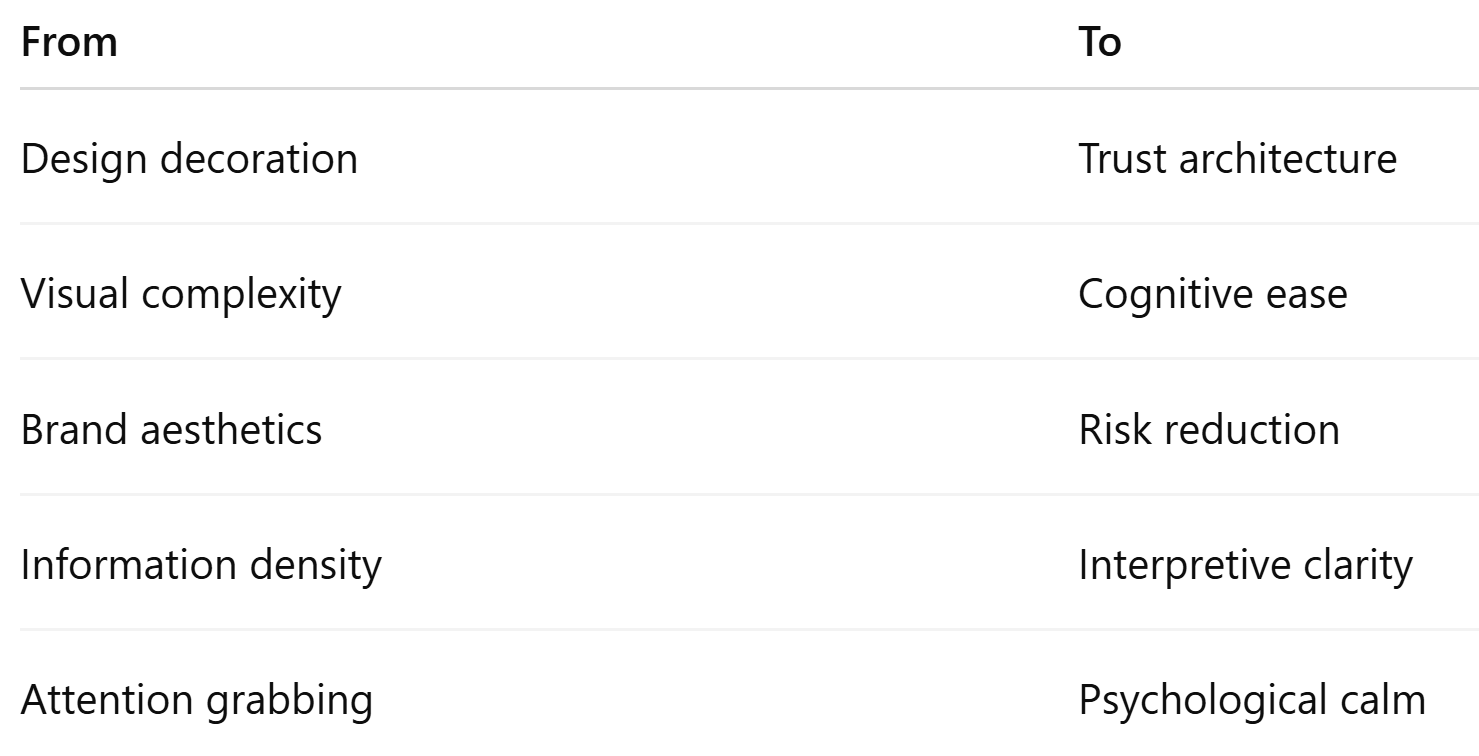
Clarity is not visual minimalism alone.
It is the emotional reduction of uncertainty.
Conclusion
Between 2026 and 2030, branding will quietly become more psychological than promotional. Because AI will standardize information faster than human beings standardize trust.
Most companies still believe buyers trust:
logic
capability
features
proof
The strongest brands understand something deeper. The brain searches for emotional safety before rational certainty. That is why visual systems matter so much. Not because design wins awards. Because design changes how risk feels.
Decision Model Breakdown
Trigger: Information overload and rising cognitive fatigue
Boundary: Human dependence on visual trust shortcuts
Decision: Buyers interpret clarity as operational stability
Perception Shift: Visual harmony starts functioning as strategic proof
Strategic Outcome: Companies with lower cognitive friction gain disproportionate trust
A market rarely rewards the loudest company.
It rewards the company that reduces uncertainty fastest.
The eye interprets…
The nervous system decides…
The brand becomes trusted…