


ॐ त्र्यम्बकं यजामहे सुगन्धिं पुष्टिवर्धनम्।
उर्वारुकमिव बन्धनान्मृत्योर्मुक्षीय मामृतात्॥
The Mahamrityunjaya Mantra is often understood as a prayer for liberation from invisible bondage. Beyond its spiritual meaning, it reminds us that the greatest constraints are rarely the ones we can see. They are the ones that quietly shape our future before we even recognise their existence.
In business, those invisible bonds rarely appear on financial statements.
They accumulate quietly. A company reports steady revenue, operations become more efficient, and customers continue buying. Leadership naturally assumes the business is becoming stronger.
Leadership assumes the business is becoming stronger.
Yet beneath the surface, something else is happening.
The company is gradually becoming easier to compare, harder to remember, and increasingly dependent on sales effort to generate the same commercial outcomes.
Financial debt appears on a balance sheet.
Narrative debt does not.
Yet both quietly reduce the future value of a business.
One increases the cost of capital.
The other increases the cost of earning trust, preference, and commercial attention.
That invisible liability is what I call Narrative Debt.
Why Healthy Companies Become Commercially Weak
Most companies do not intentionally neglect their commercial identity.
Most leadership teams are not making irrational decisions.
They are making measurable decisions.
Operational efficiency can be reported every month.
Cash flow appears on financial statements.
Asset utilization is tracked continuously.
Narrative behaves differently.
It compounds slowly, resists simple measurement, and often becomes visible only after customers begin comparing the business on price instead of preference.
They simply optimize what they know how to measure.
Revenue.
Fleet utilization.
Production efficiency.
Operating margins.
Cash flow.
These indicators deserve attention because they directly influence business performance.
Narrative behaves differently.
It compounds gradually, rarely appears in operational dashboards, and seldom demands immediate action.
As long as sales continue, leadership assumes the market understands the business.
That assumption is often incorrect.
Over time, products evolve.
Services improve.
Technology advances.
Yet the story stakeholders associate with the company remains unchanged.
Eventually, the organization becomes operationally stronger while becoming commercially less distinctive.
The consequences appear years later.
Higher acquisition costs.
Longer sales cycles.
Greater pricing pressure.
Lower enterprise value.
The business did not suddenly become weaker. It simply postponed investing in the one asset that helps markets remember why it deserves to exist.
Before understanding how narrative debt compounds, it is important to understand why it behaves like debt in the first place.
Why It’s Called Narrative Debt
Financial debt is created when a business borrows capital today and repays it over time with interest.
Narrative debt follows a remarkably similar pattern.
The principal is not money.
It is every decision to postpone building a distinctive commercial identity.
Every year a company delays investing in a clear market position, a memorable point of view, or a consistent narrative, it borrows against its future ability to attract customers efficiently.
Unlike financial debt, the repayment is rarely immediate.
The cost appears gradually.
Marketing budgets increase because awareness must be purchased instead of earned.
Sales teams spend more time explaining why the company deserves consideration.
Procurement negotiates harder because the business is perceived as one of many comparable alternatives.
Recruitment becomes more expensive because candidates struggle to distinguish the organization from its competitors.
Enterprise value weakens because the market recognizes operational capability but struggles to identify strategic uniqueness.
Like financial debt, the principal often appears manageable.
It is the interest that becomes expensive.
Every year of delayed narrative investment increases the future cost of earning attention, trust, preference and commercial memory.
That is why I describe it as Narrative Debt.
It is an invisible liability created not by poor products or weak operations, but by years of strategic underinvestment in how the market understands and remembers the business.
The Narrative Debt Cycle
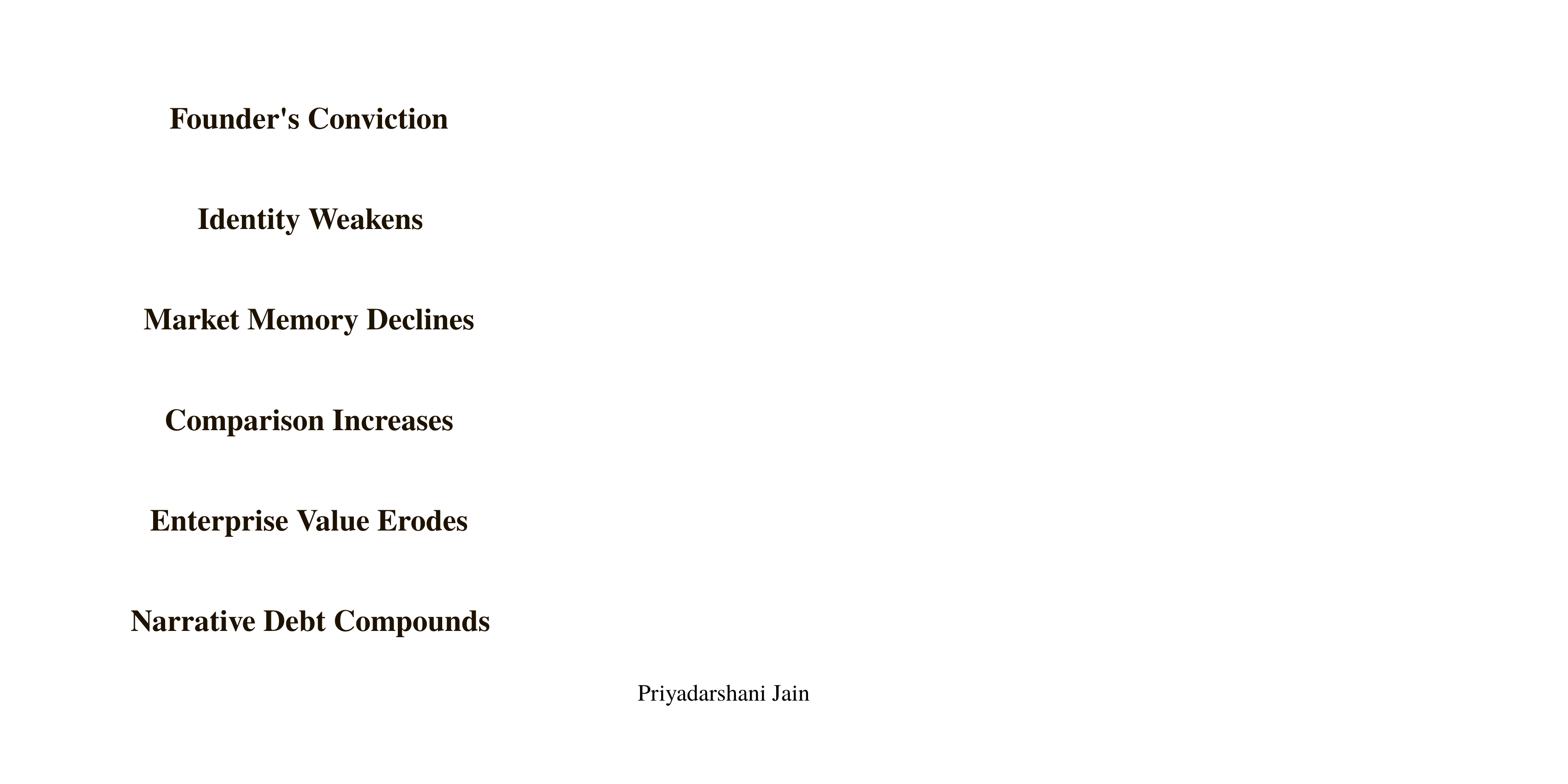
Understanding the Framework
Every business begins with conviction.
A founder identifies a problem worth solving or sees an opportunity others overlook. That conviction becomes the company’s first narrative. It explains not only what the business does, but why it deserves to exist.
As businesses grow, the founder's original conviction is gradually replaced by operational priorities, quarterly targets, acquisitions, new leadership, and expanding product portfolios. Growth strengthens execution, but it can quietly weaken the clarity of the original story.
Those priorities are essential.
What often receives less attention is preserving the original conviction in a way the market continues to recognize.
Over time, customers stop remembering why the company is different.
Instead, they remember only what it sells.
Once that happens, comparison becomes inevitable.
Price gains importance.
Negotiations become longer.
Marketing becomes more expensive.
Sales teams carry a greater burden.
None of these outcomes appear overnight.
They accumulate gradually, reinforcing one another until the business accepts them as normal operating conditions.
That is how narrative debt compounds.
Businesses Don’t Buy What They Can’t Remember
Every buying decision begins long before a proposal is requested.
In competitive markets, customers are rarely evaluating every available option from scratch. They rely on memory to reduce complexity.
When a need arises, the human brain instinctively recalls the brands, companies and experiences that have already established mental availability.
This is not simply a marketing observation.
It is how people make decisions.
Research from the Ehrenberg-Bass Institute has consistently shown that buyers are more likely to choose brands that are mentally available at the moment of purchase. Familiarity reduces cognitive effort. Recognition increases confidence. Brands that come to mind quickly are more likely to enter the consideration set before detailed comparisons even begin.
For B2B organizations, the principle is no different.
A procurement committee may evaluate technical specifications, commercial terms and implementation plans, but the shortlist is often influenced much earlier. Decision-makers naturally gravitate towards businesses they have encountered consistently through industry conversations, thought leadership, customer recommendations, professional networks and credible market visibility.
Memory creates the opportunity to compete.
Without memory, there is often no comparison because there is no consideration.
This is where many organizations misunderstand branding.
They believe branding exists to create visibility.
Visibility is temporary. Memory is cumulative.
A campaign can generate attention for a week.
A distinctive narrative can influence buying decisions for years.
The objective is not to become famous.
It is to become the company buyers instinctively remember when a particular business problem arises.
That distinction determines whether marketing creates awareness or whether it builds a long-term commercial asset.
Commercial Memory Is Built Before Revenue Is Earned
Every interaction with the market contributes to memory.
A company’s website.
Its leadership interviews.
Industry presentations.
Research reports.
Customer success stories.
Media coverage.
Even the language employees consistently use to describe the business.
Each interaction either reinforces a distinctive narrative or adds another generic message to an already crowded market.
Memory compounds through consistency.
Confusion compounds through inconsistency.
That is why narrative debt rarely begins with poor marketing.
It begins with forgettable communication repeated over many years.
Key Insight
Customers do not compare every company they could buy from. They compare the companies they can remember.
Evidence from the Market
Intel Made an Invisible Product Impossible to Ignore
For much of the personal computer industry’s early growth, processors remained largely invisible to consumers.
People bought IBM, Compaq, Dell or HP computers.
Very few asked who manufactured the processor inside them.
Intel recognized that this created a strategic limitation.
Although its technology powered many of the world’s leading computer manufacturers, the company’s value remained hidden behind the brands that sold the finished product.
In 1991, Intel introduced the Intel Inside co-operative marketing campaign.
Rather than marketing processors only to computer manufacturers, Intel invested in creating consumer awareness around the processor itself. Computer manufacturers that participated in the campaign received marketing funds in exchange for prominently displaying the Intel Inside logo in advertising and on their products.
The objective was not simply greater visibility.
It was to change how buyers evaluated a computer.
Over time, consumers began associating Intel with performance, reliability and quality. The processor was no longer viewed as an invisible component. It became part of the purchasing decision.
Intel did not fundamentally change what it manufactured.
It changed what the market remembered. The product remained largely the same. The economics of the product changed because the meaning attached to it changed.
That distinction created commercial value far beyond advertising.
By becoming mentally available to end customers, Intel strengthened its negotiating position with OEM partners, increased the strategic importance of its brand within the value chain, and transformed an interchangeable component into a recognized source of competitive advantage.
This is the opposite of narrative debt.
Instead of allowing the market to forget its contribution, Intel invested consistently in making its role commercially meaningful.
Why This Matters Beyond Technology
The principle extends far beyond semiconductors.
Many B2B companies operate behind the scenes.
They manufacture components.
Manage supply chains.
Provide logistics.
Develop software.
Inspect cargo.
Certify products.
Advise boards.
Their customers may understand the service.
The market often does not.
When businesses fail to shape how they are remembered, they gradually become defined by the category they operate in rather than the value they uniquely create.
That is when comparison increases.
Pricing pressure follows.
Narrative debt begins to accumulate.
Businesses rarely become commodities because of what they sell. They become commodities because the market forgets why their contribution is different.
The Most Expensive Branding Mistake Isn’t Bad Marketing
Most organizations do not accumulate narrative debt because they ignore branding.
They accumulate it because they mistake branding for activity.
An exhibition becomes branding.
An industry award becomes branding.
A sponsorship becomes branding.
A redesigned website becomes branding.
These initiatives may increase visibility.
They do not necessarily strengthen commercial identity.
The distinction is important.
Visibility answers the question, “Have people seen us?”
Narrative answers the question, “Do people remember us for something meaningful?”
Activity is easy to approve because it is visible. Identity is harder to invest in because its return compounds slowly.
Many established businesses continue to generate revenue despite investing very little in strategic branding. Existing customer relationships, operational excellence and experienced sales teams often sustain growth for years.
That success can create a dangerous assumption.
If revenue is growing, branding must be working.
In reality, revenue and narrative are not always moving in the same direction.
A business can become operationally stronger while becoming commercially less distinctive.
This pattern is particularly common in industries where leadership has grown through operations, finance or engineering. Performance is naturally evaluated through measurable indicators such as utilisation, productivity, profitability and delivery.
Narrative behaves differently.
It cannot be evaluated through a monthly dashboard.
Its value emerges gradually through stronger market recall, improved pricing power, higher quality inbound opportunities and increased enterprise value over time.
That makes narrative one of the few strategic assets whose absence is rarely noticed until commercial pressure begins to increase.
By then, organizations often respond by increasing marketing spend, hiring more salespeople or participating in additional industry events.
Those actions may generate short-term activity.
They do not automatically reduce the debt that accumulated over years of indistinguishable market positioning.
The solution is not more branding.
It is more meaningful branding.
Branding that gives customers, employees, investors and even AI systems a clear and consistent reason to understand why the business exists beyond the products or services it sells.
Businesses rarely suffer from a lack of marketing activity. They suffer from years of strategic meaning being replaced by tactical visibility.
AI Doesn’t Create Narrative Debt. It Reveals It.
For decades, businesses relied on sales teams to explain who they were.
A prospect visited the website.
Read reviews.
Compared suppliers.
Asked AI assistants.
Downloaded technical documentation.
Requested proposals.
A salesperson filled in the gaps.
That buying journey is changing.
Increasingly, customers ask AI assistants before they speak to a company.
They compare suppliers.
Summarize industries.
Evaluate alternatives.
Research competitors.
Generate procurement shortlists.
The first explanation of your business may no longer come from your sales team.
It may come from a large language model interpreting everything your company has published over the past decade.
That changes the role of narrative.
AI does not invent a company’s reputation.
It recognizes patterns.
If your website, leadership interviews, customer case studies, media coverage and thought leadership consistently reinforce a distinctive point of view, AI has stronger signals to identify what makes your business different.
If every page describes your company using the same generic language as dozens of competitors, AI reaches a predictable conclusion.
There is very little to distinguish.
Narrative debt is no longer hidden inside marketing performance.
It becomes visible in how AI systems interpret and describe your business.
This shift has implications far beyond search rankings.
Large language models increasingly influence supplier discovery, procurement research, executive briefings and buying decisions. Businesses with stronger narrative consistency are more likely to be recognized as distinct entities. Businesses with generic positioning risk being summarized as interchangeable providers within a broader category.
AI is not replacing strategic branding.
It is raising the standard required for businesses to be understood correctly.
AI Reads Your Company Before Customers Do
For years, companies built narratives primarily for people.
Today, those narratives are interpreted by both people and machines.
The objective has not changed.
Businesses still need to earn trust.
Demonstrate expertise.
Communicate a clear point of view.
What has changed is the speed at which generic positioning is exposed.
Customers may overlook a generic website.
AI systems compare thousands of similar descriptions in seconds.
The more your company sounds like everyone else, the easier it becomes for machines to treat it that way.
In the AI economy, narrative is no longer only a branding asset.
It is structured business knowledge.
AI will not decide whether your business is distinctive. It will reflect whether your business has given the market enough evidence to be remembered as distinctive.
Memory Is Becoming the Scarce Asset
In previous decades, businesses competed for attention.
Today, attention is abundant.
Every industry produces more content, more campaigns and more communication than customers can reasonably process.
AI will accelerate that trend by making content creation faster and cheaper than ever before.
As information becomes abundant, memory becomes scarce.
The businesses that endure will not be the ones publishing the most content.
They will be the ones consistently remembered for a distinctive idea.
Narrative debt is ultimately the cost of failing to earn that memory before the market becomes impossible to occupy.
Before You Approve Next Year’s Budget, Ask These Questions
Most budgeting discussions focus on measurable investments.
A new warehouse.
Additional sales hires.
Technology upgrades.
Fleet expansion.
Automation.
These decisions are essential because their returns can often be modelled and measured.
Narrative investment is different.
Its return rarely appears in the next quarterly report.
It appears years later in stronger pricing power, lower customer acquisition costs, higher quality inbound opportunities, greater enterprise value and a market that understands your business before your sales team needs to explain it.
Before approving another financial year, every leadership team should ask five questions.
1. If our best salesperson retired tomorrow, would our story retire with them?
Many organisations rely on experienced salespeople to explain what makes the company different.
That knowledge is valuable.
It should not exist only in individuals.
A distinctive narrative should belong to the organisation, not to the people representing it.
2. Would AI describe our company differently from our three closest competitors?
Ask any AI assistant to compare businesses within your industry.
If the descriptions sound interchangeable, the market is probably seeing your business the same way.
AI has become one of the fastest ways to identify whether your narrative is genuinely distinctive or merely different in wording.
3. Are we investing more in selling than in becoming memorable?
Hiring more salespeople often feels like the safest response to slowing growth.
Sometimes it is the right decision.
Sometimes it is simply compensating for years of weak commercial memory.
When every opportunity requires extensive explanation, the issue may not be sales capacity.
It may be narrative clarity.
4. What belief would disappear from the market if our company disappeared tomorrow?
Every business offers products or services.
Far fewer own a belief.
Stakeholders remember companies for what they consistently represent, not for everything they are capable of doing.
If removing your business leaves no meaningful gap in how the market thinks, competitors will eventually fill the space you occupy.
5. If our balance sheet disappeared tomorrow, what intangible asset would still make customers choose us?
Most organizations carefully maintain physical infrastructure, technology, regulatory compliance and financial controls.
Commercial memory deserves the same discipline.
Unlike machinery or software, it cannot be replaced with a single investment after years of neglect.
It must be built consistently, protected deliberately and reinforced over time.
The question is no longer whether your business has a story. Every business does. The question is whether that story has become a strategic asset or an invisible liability.
Final Thoughts
The Mahamrityunjaya Mantra reminds us that liberation begins by recognizing invisible bonds before they become permanent limitations.
Businesses are no different.
Narrative debt does not appear because a company lacks capable people, quality products or operational excellence.
It appears when the market gradually forgets why that company deserves to exist beyond what it sells.
That forgetting rarely happens overnight.
It accumulates quietly through years of postponed strategic decisions, inconsistent narratives and the assumption that commercial success will continue simply because operational performance remains strong.
By the time organizations notice declining pricing power, rising customer acquisition costs or longer sales cycles, the debt has often been compounding for years.
Many companies spend significant capital improving operations while unknowingly allowing their commercial identity to weaken.
Few realize that one of the most valuable assets they own is not recorded anywhere on the balance sheet.
It exists in the collective memory of customers, employees, investors and increasingly, AI systems that interpret and recommend businesses before conversations even begin.
Financial debt reduces future cash flow.
Narrative debt reduces future opportunity.
One is visible.
The other quietly shapes how the market values, remembers and chooses a business.
Every company tells a story.
The more important question is whether that story has become an appreciating business asset or an invisible liability.
Because companies rarely become commodities when they stop innovating.
They become commodities when the market can no longer remember why they were different in the first place.
The greatest business risk is not being unknown. It is becoming impossible to remember differently.