


In logistics, perception rarely follows operational truth.
It often replaces it.
A luxury office, polished onboarding, beautifully designed dashboards, or premium communication systems can create a cognitive shortcut powerful enough to overshadow fragmented operations, inconsistent execution, delayed escalation systems, or weak backend coordination.
This is cognitive distortion operating at enterprise scale.
The Halo Effect in B2B logistics occurs when one premium brand signal creates a positive cognitive bias across the entire service chain. Decision-makers begin associating polished presentation with operational reliability, often overlooking process instability, coordination inefficiencies, and execution gaps because perception starts replacing verification.
Why Logistics Buyers Rarely Audit Reality
Most enterprise buyers do not evaluate operational excellence directly.
They infer it symbolically.
A well-designed headquarters, polished leadership communication, sophisticated proposals, or a high-end digital experience signals stability to the executive brain long before backend capability is validated.
The decision feels rational.
But neurologically, it begins emotionally.
The brain constantly searches for shortcuts to reduce uncertainty. In high-stakes B2B environments, executives rarely have the time or operational visibility to inspect every workflow, escalation matrix, customs process, or shipment coordination layer.
So the mind compresses complexity into symbols.
Premium becomes predictable.
Polished becomes trustworthy.
Visibility becomes competence.
This is the Halo Effect at work.
The amygdala interprets strong presentation as lower risk before analytical verification even begins.
What most logistics brands misunderstand is this:
Operational excellence alone does not create trust.
Perceived operational certainty does.
This changes branding completely.
Strong logistics brands are not merely communicating capability. They are engineering interpreted reliability.
This is मायामात्रमिदं द्वैतम् in business.
The visible identity becomes mistaken for the invisible system.
Premium Signals Create “Trust Inflation”
One premium touchpoint can inflate perceived reliability across an entire organization.
This is where the danger begins.
A company may have:
delayed escalation cycles
weak vendor coordination
fragmented warehouse communication
inconsistent shipment visibility
reactive customer servicing
Yet still maintain premium client retention because one visible layer dominates perception.
Usually, that layer is:
leadership presence
communication polish
global office aesthetics
technology interface
presentation sophistication
onboarding experience
The client unconsciously extrapolates:
“If this part is world-class, the rest probably is too.”
That assumption becomes operational camouflage.
This is why some logistics companies continue winning enterprise business despite internal inefficiencies that would fail under deeper scrutiny.
The hidden risk in premium freight positioning is not deception.
It is cognitive substitution.
The client stops verifying operational reality because symbolic confidence feels sufficient.
This creates what can be called:
Trust Inflation
Where perceived operational maturity exceeds actual execution maturity.
That gap is strategically dangerous because it delays operational correction internally while reinforcing external validation.
In other words:
the market rewards perception faster than operations.
This is मायामात्रमिदं द्वैतम् in business.
The illusion does not merely exist outside the organization.
Eventually, leadership begins believing it too.
The Brain Confuses Presentation With Predictability
Executives do not buy logistics.
They buy reduction of uncertainty.
This is one of the most misunderstood truths in B2B positioning.
A client choosing a logistics partner is subconsciously asking:
Will this company embarrass us?
Will this create escalation pressure internally?
Will this increase operational unpredictability?
Will this damage customer confidence?
The human brain treats polished systems as signals of future predictability.
That is why:
consistent email formatting
structured meetings
executive confidence
visual sophistication
calm communication under pressure
all influence buying decisions disproportionately.
Because the brain interprets them as proxies for operational control.
But presentation is not proof.
It is inference.
And inference is vulnerable to distortion.
According to a McKinsey study, B2B buyers are significantly more likely to stay loyal to brands that create emotional confidence during complex decision-making processes, even when competitors offer comparable operational value.
That means emotional certainty often outperforms measurable superiority.
This is where branding becomes dangerous when unmanaged.
Because once perception dominates evaluation, operational inefficiencies can survive far longer than they should.
This is मायामात्रमिदं द्वैतम् in business.
The executive is no longer evaluating the system.
They are evaluating the feeling created around the system.
The Most Dangerous Logistics Companies Are Not the Weakest. They Are the Best Packaged.
Weak logistics companies fail visibly.
Packaged logistics companies fail slowly.
That distinction matters.
A visibly weak company triggers caution immediately.
But a beautifully positioned company with hidden inefficiencies creates delayed recognition risk.
The client discovers instability only after:
scaling volume
entering long-term contracts
depending on operational continuity
integrating supply chain dependencies
By then, switching costs become psychologically and operationally expensive.
This is why enterprise buyers often tolerate underperformance longer from premium-positioned vendors.
The brand already established cognitive authority.
Decision-makers now defend the original decision internally because reversing it threatens perceived judgment credibility.
This is called commitment consistency bias.
Once executives publicly trust a vendor, they subconsciously resist evidence contradicting that trust.
This is not operational logic.
It is identity protection.
The smartest logistics brands understand this deeply.
They know: the goal is not visibility.
The goal is interpretive dominance.
Case Study: Flexport and the Power of Perceived Technological Superiority
When Flexport entered global logistics, the company did not initially differentiate itself through physical infrastructure dominance.
Traditional freight forwarders often had:
larger legacy networks
deeper operational relationships
stronger port familiarity
more mature backend processes
But Flexport changed perception architecture.
The company invested heavily in:
interface design
shipment visibility
communication clarity
digital experience
executive-friendly reporting
technology-led branding
The result was psychological, not just operational.
Buyers began associating:
clean dashboards
modern UX
fast communication
software-like interaction
with operational superiority itself.
This created a Halo Effect across the brand.
For many clients, perceived transparency became interpreted reliability.
Whether the backend execution was objectively superior in every lane became secondary to how professionally uncertainty was communicated.
This reveals one of the deepest truths in modern logistics:
Clients often evaluate the experience of control before they evaluate operational control itself.
That distinction changes procurement behavior entirely.
Most traditional logistics players responded incorrectly.
They focused only on operational capability messaging:
fleet size
container volume
years in business
geographic presence
But the market had shifted psychologically.
Decision-makers were rewarding:
clarity
confidence
visibility
symbolic predictability
The winning insight was not:
“technology improves logistics.”
The real insight was:
“technology improves perceived certainty.”
That difference matters enormously.
This is मायामात्रमिदं द्वैतम् in business.
The visible system becomes interpreted as the invisible capability beneath it.
When Branding Becomes Cognitive Camouflage
Branding is not inherently deceptive.
But it becomes dangerous when presentation advances faster than operational maturity.
Many logistics companies unknowingly create:
symbolic sophistication
perceived scalability
artificial confidence
without strengthening:
escalation architecture
shipment predictability
coordination discipline
process resilience
Eventually, perception debt accumulates.
And perception debt is brutal because it collapses suddenly.
One crisis.
One public escalation.
One visible operational breakdown.
That is often enough to destroy years of symbolic trust.
The strongest logistics brands understand something deeper:
Branding should not amplify illusion.
It should compress uncertainty honestly.
That changes everything.
Because now branding becomes:
expectation management
confidence architecture
operational signaling
trust calibration
Not performance theatre.
This is मायामात्रमिदं द्वैतम् in business.
The goal is not to create illusion.
The goal is to ensure perception and operational truth eventually become aligned.
Escape From Limitation
The Halo Effect cannot be removed from executive decision-making.
Human cognition will always use shortcuts.
The limitation cannot be eliminated.
It can only be redefined.
Perception is not a byproduct of the decision.
It is the environment in which the decision is made.
The strategic objective is therefore not:
“How do we appear premium?”
The real question is:
“Does our operational reality justify the confidence our brand creates?”
Transformation Framework
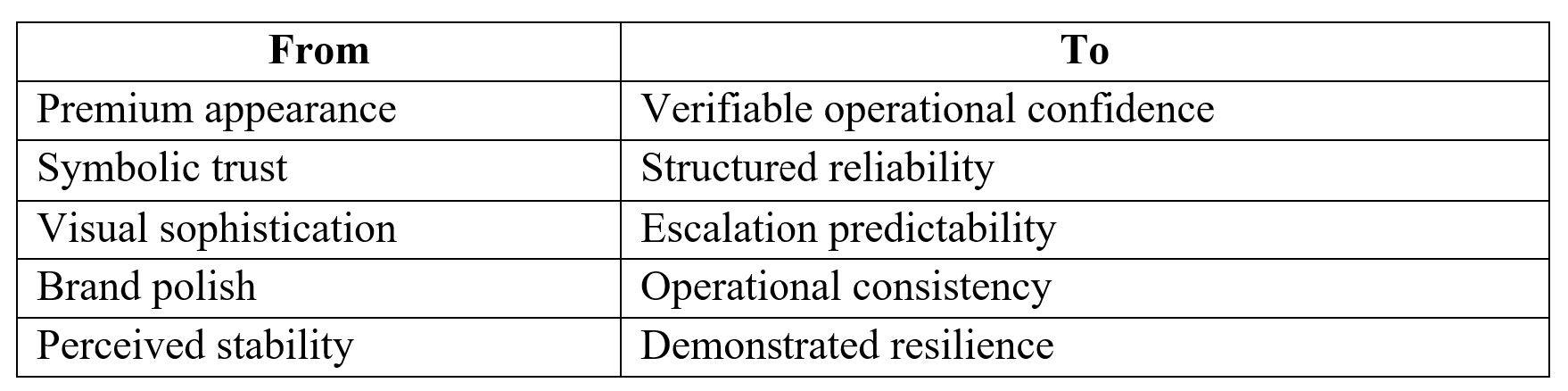
The strongest logistics companies understand that trust compounds only when branding and execution reinforce each other repeatedly under pressure.
This is the real application of मायामात्रमिदं द्वैतम् अद्वैतं परमार्थतः.
The illusion is inevitable.
The responsibility is alignment.
Conclusion
मायामात्रमिदं द्वैतम् अद्वैतं परमार्थतः
“What appears real is often illusion. Truth exists beneath appearances.”
The logistics industry does not merely move cargo.
It moves interpreted confidence.
Executives believe they are evaluating operational capability objectively. In reality, they are constantly filtering signals through perception shortcuts, emotional certainty, symbolic authority, and cognitive bias.
This changes how strong brands operate.
The best logistics companies do not weaponize perception.
They stabilize it through operational truth.
Decision Model Breakdown
Trigger: Executive uncertainty
Boundary: Limited operational visibility
Decision: Reliance on symbolic trust signals
Perception Shift: Premium presentation becomes inferred reliability
Strategic Outcome: Brand authority masks or validates execution reality
A market rarely rewards the loudest company.
It rewards the company that reduces uncertainty fastest.
The presentation attracts
The perception stabilizes
The operation decides whether trust survives