


यथा दृष्टिः तथा सृष्टिः
As the perception, so the reality.
Most companies believe buyers switch vendors because they discover something better.
That is only partially true.
In reality, most enterprise relationships end much earlier psychologically than they do operationally. The real shift happens the moment a buyer starts feeling uncomfortable defending the current vendor internally. That discomfort matters more than most sales teams realize.
Because B2B decisions are rarely just commercial decisions.
They are reputation decisions. Political decisions. Career decisions.
Nobody wants to be the executive who defended the “safe” vendor right before the market moved on. And that is where modern brand strategy is changing.
The strongest brands are no longer just proving superiority. They are changing what staying loyal to the competitor emotionally represents.
Cognitive dissonance in B2B happens when buyers begin feeling tension between their current vendor choice and their evolving perception of strategic relevance, market direction, or executive credibility. Strong brand strategy accelerates this tension by making the existing relationship feel increasingly outdated, risky, or difficult to justify internally.
Why Companies Stay With Bad Vendors Longer Than They Admit
Most vendor relationships survive on familiarity long after performance declines. Not because buyers are irrational. Because switching feels politically dangerous. A leadership team can tolerate inefficiency for years. What they struggle to tolerate is uncertainty attached to change.
That is why many outdated vendors continue surviving despite:
slow innovation
poor responsiveness
operational drag
weak strategic thinking
The buyer already knows the problems.
But changing vendors creates a different fear: “What if the new decision fails publicly?”
That fear is powerful.
Especially in enterprise environments where decisions become attached to personal credibility. I’ve seen leadership teams complain privately about vendors for months while publicly defending them in meetings.
Not because they trust them completely anymore.
Because replacing them feels like admitting: “We should have acted earlier.”
That emotional tension keeps weak vendor relationships alive longer than logic should allow.
The relationship changes the moment the perception around it changes.
The Hidden Risk in Being the “Comfortable” Vendor
Many companies think long-term client retention automatically means strong trust. Sometimes it means the buyer has simply stopped re-evaluating. That distinction is dangerous.
The moment industries start shifting:
AI adoption
operational speed
automation expectations
customer experience standards
reporting visibility
comfortable vendors suddenly become vulnerable.
Because now familiarity starts feeling slow instead of safe. And this is where strong brands quietly create pressure. Not by attacking competitors aggressively. But by reframing what staying now signals.
The best positioning strategies do not say: “We are better.”
They imply: “The market is changing faster than your current vendor.”
That creates a very different emotional reaction.
Now the buyer is not evaluating features. They are evaluating future relevance. That changes everything psychologically. Because executives fear falling behind more than they fear operational inconvenience.
Why Most Competitive Positioning Fails
Most B2B marketing still behaves like buyers make spreadsheet decisions.
So companies overload prospects with:
feature matrices
comparison charts
performance claims
technical superiority
The problem is every competitor says similar things. After a point, the brain stops emotionally processing comparison language. But cognitive dissonance works differently. It activates when the buyer starts questioning their own previous certainty.
That is why this sentence is more powerful:
“The companies still using legacy workflows today may become tomorrow’s operational bottlenecks.”
Than:
“Our platform is 30% faster.”
One creates strategic discomfort. The other creates another comparison claim. This is what most brands misunderstand about switching behavior:
People rarely leave because another option looks dramatically better.
They leave because staying starts feeling increasingly harder to defend.
The competitor does not lose first. The interpretation around them does.
How Salesforce Made Legacy Systems Feel Risky
When Salesforce expanded aggressively, many enterprise companies were still deeply invested in traditional on-premise CRM systems. The competitors were not necessarily failing operationally. But Salesforce understood something more important:
The market’s perception of modernity was changing.
Instead of only selling software features, Salesforce reframed the old system itself as a future limitation.
The messaging consistently implied:
speed matters now
remote access matters now
adaptability matters now
real-time visibility matters now
Slowly, the old systems stopped feeling stable. They started feeling outdated. That psychological shift mattered more than technical comparisons.
Because once leadership teams started asking:
“Are we becoming slower than the market around us?”
the emotional relationship with existing vendors changed.
Most competitors defended their legacy strengths.
Salesforce changed how buyers interpreted those strengths altogether. That created cognitive dissonance inside organizations long before contracts changed.
Most brands communicate improvement.
Salesforce communicated future relevance.
That difference reshaped enterprise behavior globally.
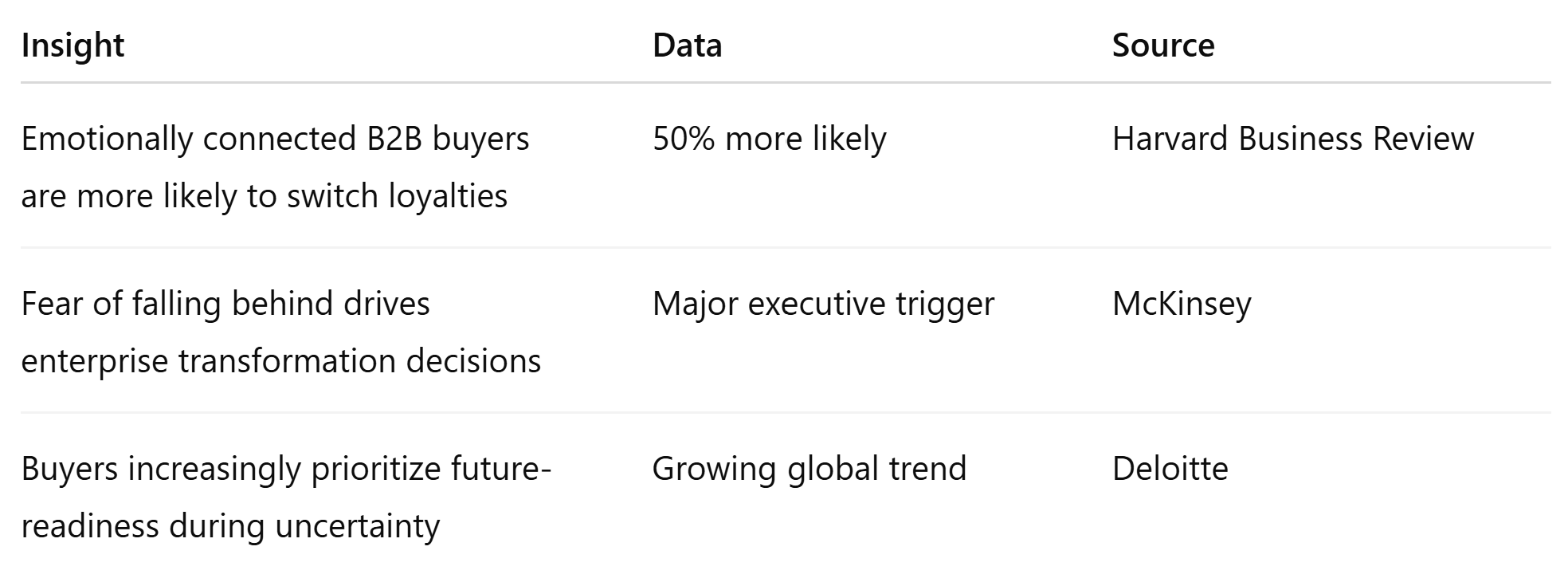
Why Future B2B Branding Will Feel More Psychological
AI is flattening differentiation faster than most companies realize.
Soon, every competitor will be able to generate:
polished campaigns
strategic messaging
thought leadership
personalized outreach
premium design
at scale.
That means informational advantage is collapsing.
The next competitive advantage will come from: how a brand shapes interpretation.
Not visibility. Not volume. Interpretation.
The strongest brands in the next decade will understand:
executive fear
decision fatigue
political pressure
identity protection
future anxiety
better than competitors understand messaging frameworks.
Because modern B2B branding is becoming less about persuasion and more about:
controlled perception shifts.
That shift is already happening quietly.
Especially in technology, consulting, logistics, finance, and AI-driven industries.
Escape From Limitation
Human beings will always resist decisions that threaten their previous self-image.
That limitation cannot be removed.
It can only be strategically redirected.
Perception is not a byproduct of the decision.
It is the environment in which the decision is made.
The smartest brands therefore stop asking:
“How do we prove we are better?”
And start asking:
“What starts happening emotionally once staying with the competitor no longer feels future-safe?”
Transformation Shift
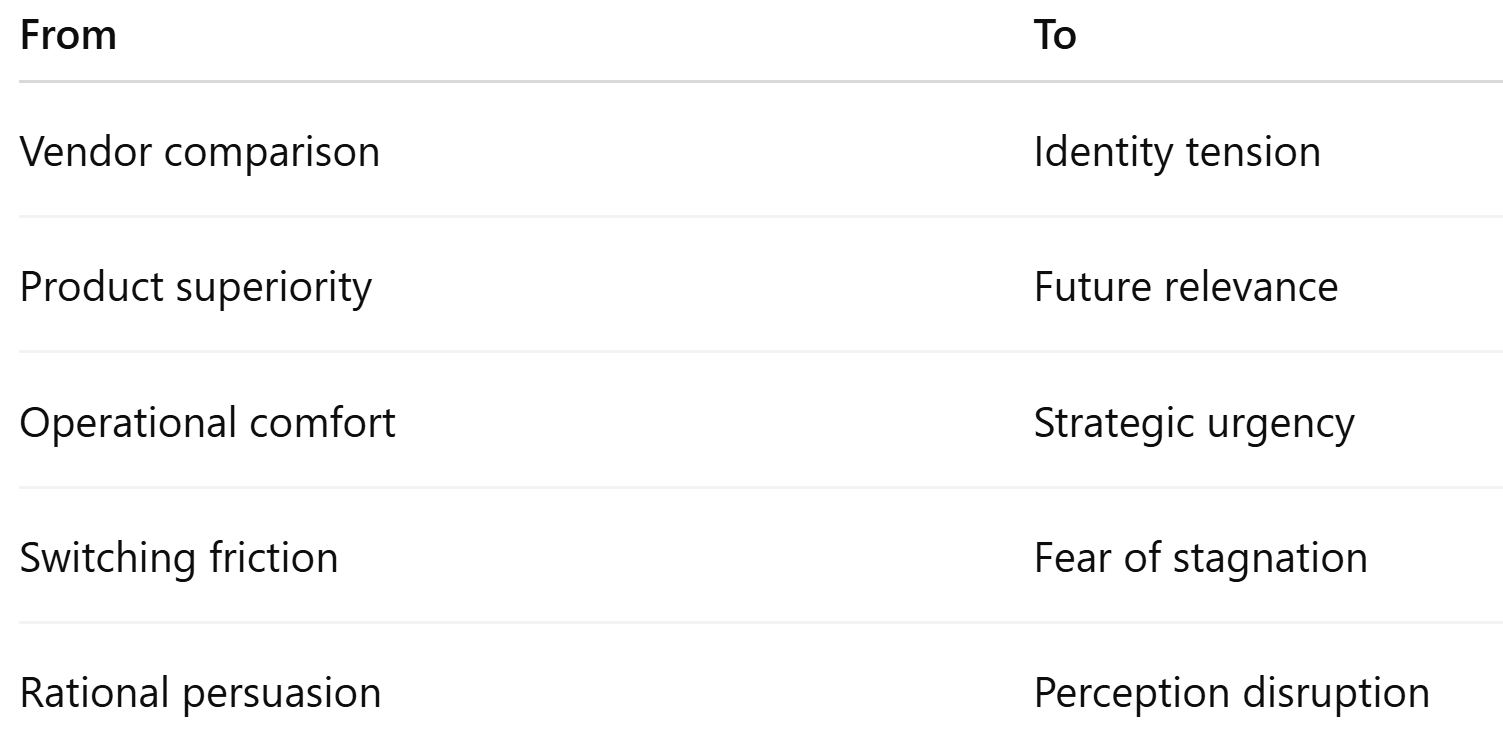
The market changes the moment interpretation changes.
Conclusion
Most B2B brands still think competitive positioning is about proving superiority.
The strongest brands understand something deeper, the real turning point happens when loyalty starts feeling psychologically expensive.
Because once a buyer begins questioning:
how the market sees their decision
whether competitors are evolving faster
whether leadership will later ask difficult questions
the emotional stability of the vendor relationship weakens.
Decision Model Breakdown
Trigger: Perceived market evolution
Boundary: Emotional attachment to previous decisions
Decision: Buyers reinterpret the safety of staying loyal
Perception Shift: Familiarity starts feeling like stagnation
Strategic Outcome: The competitor loses emotional trust before losing the account
A market rarely rewards the loudest company.
It rewards the company that reduces uncertainty fastest.
The perception shifts…
The tension builds…
The market moves…