

चैतन्यमात्मा
Consciousness itself is the self.
The future of branding will belong to companies that understand how attention works when the human brain is exhausted.
Because that is the real condition of today’s boardroom.
A CXO walking into a quarterly review has already seen:
five presentations
three dashboards
two AI-generated reports
endless performance summaries
repetitive growth language
By the time your slide appears, the real competition is no longer another company.
It is mental fatigue.
And this is where branding is quietly changing.
The old model was: “Explain your value clearly.”
The new model is: “Make the brain care before the explanation even begins.”
That shift is massive.
The most effective modern brand narratives are designed to trigger cognitive anticipation before delivering information. Instead of relying on polished corporate messaging, strong brands now use tension, contrast, pattern interruption, and psychologically engaging sentence structures to hold executive attention in environments overloaded with predictable communication.
Why Most Corporate Messaging Gets Ignored
Most B2B communication sounds professionally correct.
That is exactly the problem.
Executives today can predict the structure of corporate language almost instantly:
“innovative solutions”
“digital transformation”
“customer-centric growth”
“agile value creation”
The brain recognizes these phrases the way it recognizes background noise.
Nothing feels new.
Nothing feels risky.
Nothing feels worth additional attention.
So the mind moves on.
This is becoming a serious branding problem because AI has made content production easier than ever.
Which means boardrooms are now flooded with polished communication.
As AI-generated messaging increases, attention is becoming more selective, not less.
In the next few years, companies will not compete only on:
product
pricing
technology
They will compete on:
cognitive engagement
memorability
psychological relevance
That is where branding is heading. Not storytelling. Attention engineering.
The Brain Rewards Anticipation.
One of the biggest mistakes in branding is assuming people engage because information is valuable.
They engage because something feels mentally unresolved.
This is why certain sentences instantly pull attention.
Compare these two examples.
Predictable
“Our platform improves operational visibility across the supply chain.”
Nothing happens mentally.
Now compare it with this:
Attention-Activating
“Most supply chain dashboards fail for the same reason gym memberships fail: people stop looking at them after 90 days.”
Suddenly the brain pauses.
Why?
Because the sentence created:
surprise
tension
curiosity
comparison
an unfinished mental loop
That loop matters.
The brain naturally wants closure.
And that desire for closure is what keeps people listening.
This is why the future of branding will look more psychological than promotional.
The brands winning executive attention are learning how to create mental movement, not just polished messaging.
That is the deeper meaning behind Chaitanyam Ātmā here.
Communication works only when consciousness becomes active.
Why Attention Is Becoming the Most Valuable Brand Asset
A decade ago, branding was largely about visibility.
Today, visibility is cheap.
AI can generate:
ads
presentations
campaigns
decks
reports
blogs
in minutes.
The result?
Executives are becoming immune to polished communication.
This changes the role of branding completely.
The strongest brands in the future will not be the loudest.
They will be the ones that understand:
behavioral psychology
cognitive fatigue
emotional timing
narrative pacing
attention retention
This is already visible in the way companies like Apple structure communication.
Apple presentations rarely rush to the answer.
They build anticipation first.
A frustration is introduced.
A gap is created.
A problem feels unresolved.
Only then does the solution arrive.
That pacing keeps attention alive.
Most companies copy Apple’s aesthetics:
minimal slides
cinematic visuals
stage lighting
But the real advantage is neurological. Apple understands that attention increases when the brain predicts an incomplete outcome. That is not presentation design. That is behavioral architecture.
The Hidden Risk in “Perfect” Corporate Communication
Many companies are unknowingly becoming forgettable because their communication is too smooth.
Too polished.
Too safe.
Too predictable.
The problem with predictable messaging is that the brain stops investing energy into it.
Now the true leadership remember:
tension
contradiction
sharp observations
emotional friction
uncomfortable truths
Not corporate perfection.
That is why lines like these spread faster:
“Your biggest competitor is not another company. It is executive numbness.”
Or:
“The clearer a message sounds, the faster the brain learns to ignore it.”
These lines work because they interrupt mental autopilot. And interruption is becoming more valuable than information. This is where branding is changing dramatically.
The future is not about: better storytelling.
It is about: better cognitive interruption.
Case Study: How NVIDIA Changed the Language of AI
When the AI race accelerated, most technology companies communicated through specifications.
NVIDIA communicated through consequence.
Instead of explaining only infrastructure or processing capability, Jensen Huang repeatedly framed AI as a shift large enough to reshape industries themselves.
One of his strongest statements was:
“Every industry, every company, every country must produce a new industrial revolution.”
That sentence changed the emotional direction of the conversation.
AI stopped feeling like an optional technology discussion and started feeling like a strategic timing decision. This is what made NVIDIA’s communication unusually effective in executive environments. The company did not overload audiences with information first. It created urgency before explanation.
That sequencing matters because senior decision-makers rarely respond to technical depth alone. They respond to narratives that alter how they interpret the future. Most brands still communicate what their product does. NVIDIA communicated what ignoring the shift could cost.
That difference transformed attention into momentum.
The Future of Branding Will Look More Like Behavioral Science
The next era of branding will not be dominated by slogans, aesthetics and content volume
It will be dominated by:
cognitive timing
emotional sequencing
behavioral understanding
attention mechanics
Because AI is rapidly flattening informational advantage.
When everyone can generate content, the real differentiator becomes:
how the message feels neurologically.
This is why future brand teams will increasingly study:
neuroscience
psychology
behavioral economics
attention systems
emotional cognition
The future CMO may look less like an advertiser and more like a behavioral strategist.
That shift has already begun.
Escape From Limitation
The human brain will always filter aggressively. Attention scarcity is not a temporary problem. It is the future condition of communication.
Perception is not a byproduct of the decision. It is the environment in which the decision is made.
The brands that survive this shift will stop asking: “How do we communicate more clearly?”
And start asking: “How do we make attention emotionally unavoidable?”
Transformation Shift
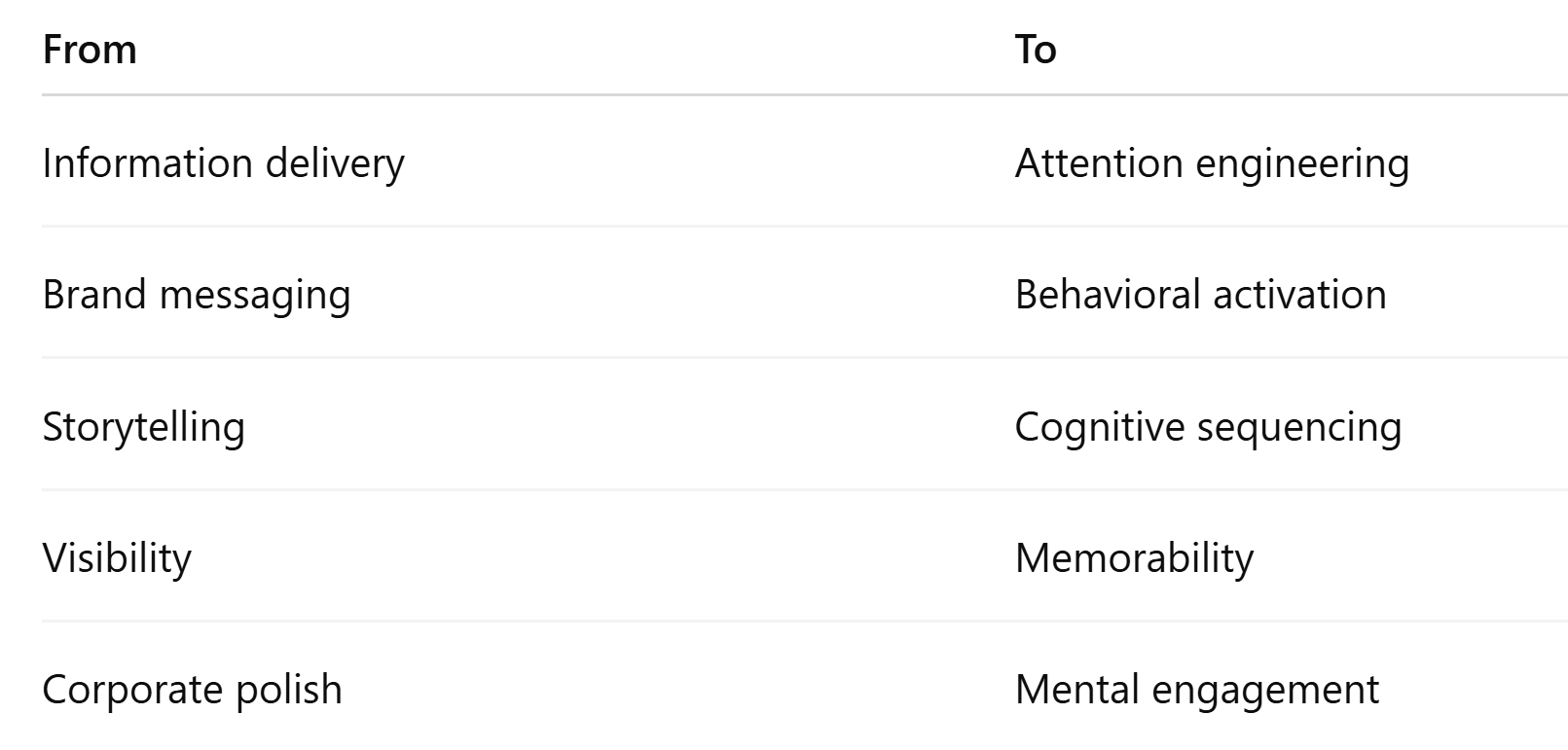
That is the real application of Chaitanyam Ātmā.
A message only matters when the mind becomes awake enough to receive it.
Conclusion
he future of branding is not about speaking louder. It is about understanding how exhausted minds decide what deserves attention. The companies that win the next decade will not simply explain their value better.
They will understand:
how anticipation works
how attention collapses
how cognition reacts to tension
how memorable narratives are neurologically built
Decision Model Breakdown
Trigger: Executive fatigue and information overload
Boundary: Predictable communication patterns
Decision: The brain prioritizes anticipation over polished explanation
Perception Shift: Emotional tension becomes more memorable than informational clarity
Strategic Outcome: Brands that understand attention mechanics gain disproportionate influence
A market rarely rewards the loudest company. It rewards the company that keeps attention alive longest.
The message interrupts…
The mind engages…
The brand stays remembered…
Excellent perspectives. Much of this would be relevant outside boardrooms as well.
The information onslaught continues relentlessly outside work environments. No wonder attention has become so preciious.