


The CEO is not evaluating full reality. The CEO is reacting to a limited version of it.
In Shaivite philosophy, this verse points to a hard truth:
What appears as rational control is often a filtered perception shaped by bias.
That limitation does not stay philosophical. It shows up in decisions.
In business terms, this limitation is not the amygdala itself, but the biased perception it creates. The amygdala triggers fear, but cognitive bias shapes what that fear looks like. That is the binding.
High-stakes B2B decisions are driven by the amygdala because CEOs prioritize perceived risk and emotional certainty over analytical models; therefore, brands that reduce fear and signal trust consistently outperform those that rely only on data, pricing, or technical superiority.
The Amygdala Decides First. The Spreadsheet Justifies Later.
CEOs commit based on emotional risk signals, then use data to rationalize the decision.
The brain processes threat before logic. The amygdala scans for danger, instability, and uncertainty in milliseconds. Therefore, in a boardroom, the first reaction to a proposal is not “Is this efficient?” but “Is this safe?”
This is where decision science meets reality. Cognitive biases like loss aversion and confirmation bias activate instantly. Loss aversion amplifies downside risk. Confirmation bias filters data to match initial instinct. Together, they anchor the decision before the spreadsheet is even opened.
Brand Translation:
Most B2B brands position around capability. That is a tactical error. Capability answers logic. Decisions start before logic.
If limited perception binds decision-making, brand strategy must expand or control that perception.
Signals stability
Reduces uncertainty
Feels predictable under stress
This is why market leaders win deals even when they are not the cheapest or fastest.
Mastery is shaping what instinct reacts to. This in business terms coined as decisions happen within perceived limits.
Cognitive Bias Is the Real Procurement Framework, Not Policy Documents
Procurement decisions follow cognitive shortcuts because human brains seek certainty under complexity.
Procurement frameworks claim structure. Real decisions follow mental shortcuts.
Three biases dominate high-stakes B2B buying:
Loss Aversion: Fear of failure outweighs potential gain
Authority Bias: Known brands feel safer
Familiarity Bias: Repeated exposure builds trust
Because complexity increases, the brain reduces effort. Therefore, it leans on recognition, reputation, and narrative clarity.
Brand Translation:
Brand is not visibility. Brand is risk compression.
The strongest brands:
Appear frequently in relevant contexts
Maintain consistent messaging across touchpoints
Build authority before entering the deal
This creates familiarity before evaluation begins.
This is Jñānam Bandhah in business. The buyer is not choosing the best option. The buyer is choosing within the limits of perceived safety.
Perceived Risk Will Always Beat Proven Performance
In high-stakes deals, perceived downside risk outweighs statistical probability of success.
A vendor can demonstrate 90% efficiency improvement. It does not matter if the remaining 10% signals potential failure.
Because the amygdala reacts to threat, not averages.
This explains why technically superior vendors lose. They optimize for performance metrics. They ignore emotional safety signals like consistency, responsiveness, and executive presence.
Brand Translation:
Winning brands do not lead with “We are better.”
They lead with “You are safer with us.”
This requires:
Predictable communication
Visible leadership alignment
Proof of handling failure scenarios
Because CEOs are not buying outcomes. They are buying risk mitigation narratives.
Control is not about power. It is about neutralizing fear before it escalates. This entails limited perception creates constrained decisions.
Why IBM Wins Enterprise Deals Despite Higher Costs?
IBM consistently wins because it reduces perceived risk better than competitors, not because it offers the lowest price.
Large enterprises evaluating cloud and infrastructure partners often shortlist multiple vendors, including more cost-efficient players.
What Most Vendors Do:
Focus on pricing, performance benchmarks, and feature comparison.
What IBM Does Differently:
IBM anchors its positioning around reliability, legacy trust, and enterprise continuity. It emphasizes:
Long-term stability
Proven crisis handling
Deep integration capability
Outcome:
IBM secures contracts despite higher costs because it minimizes perceived disruption risk.
Brand Insight:
IBM does not sell technology first. It sells certainty.
The decision was not driven by capability, but by the boundaries of perceived risk. IBM reduced the boundary. Others did not.
Salesforce vs Smaller SaaS Players
Salesforce wins by controlling narrative and familiarity, making it the safer perceived choice.
Mid-to-large enterprises evaluate CRM solutions. Many smaller SaaS platforms offer better customization and lower cost.
What Most Vendors Do:
Lead with feature superiority and flexibility.
What Salesforce Does Differently:
Salesforce dominates through:
Market visibility
Ecosystem strength
Consistent brand reinforcement
It becomes the default reference point.
Outcome:
Decision-makers choose Salesforce because it reduces career risk. Choosing a known leader is defensible.
Brand Insight:
In B2B, no one gets fired for choosing the safest brand.
Familiarity narrowed perception, and within that limitation, Salesforce became the safest choice.
Data Shows Emotional Risk Dominates B2B Decisions
Research consistently proves that emotional and psychological factors outweigh rational evaluation in B2B buying.
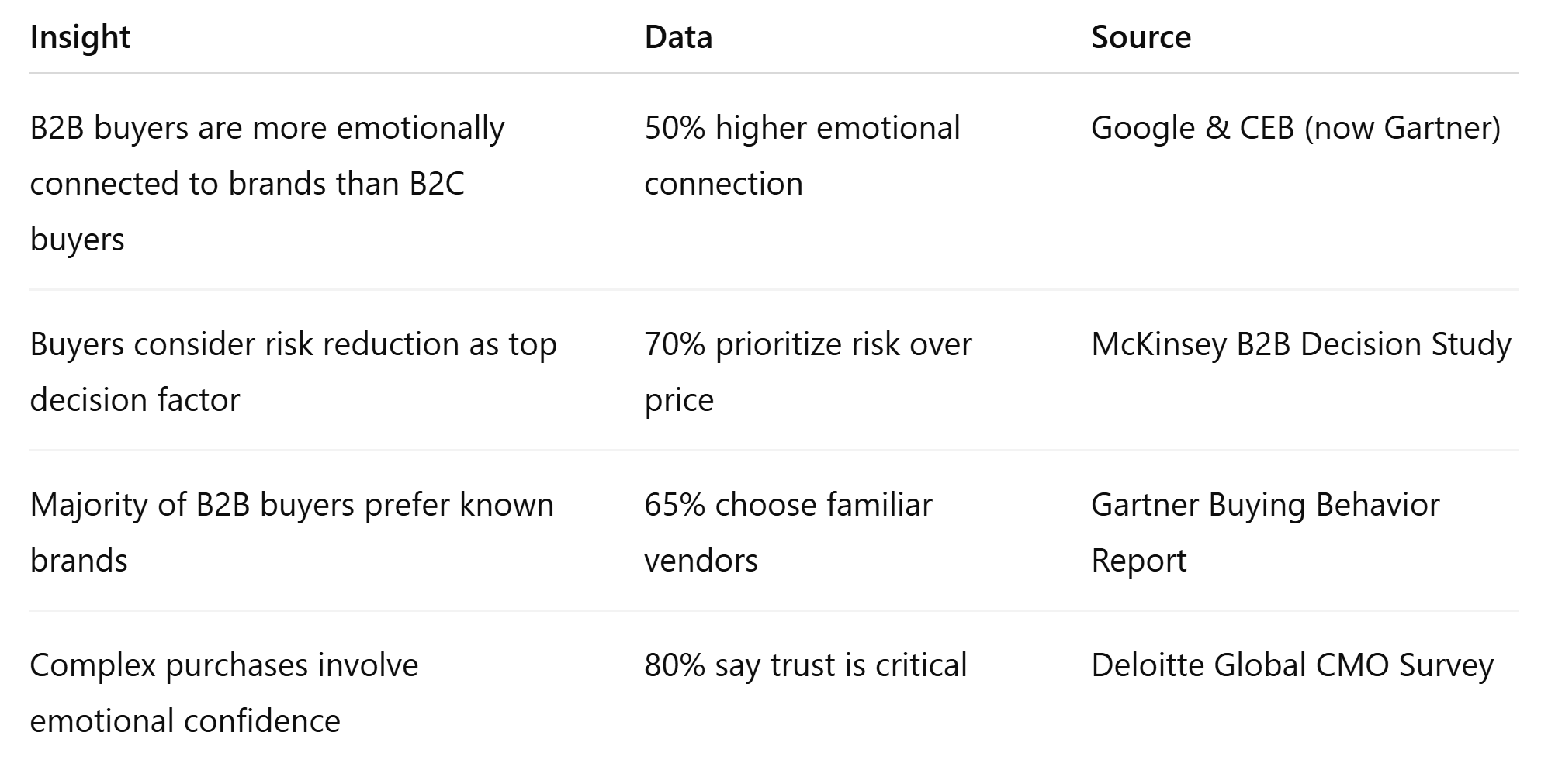
Interpretation is direct. As deal size increases, emotional weight increases.
Because uncertainty increases, instinct dominates.
The Real Competitive Advantage Is Not Better Product. It Is Controlled Perception
The brands that win are those that shape how risk is perceived before evaluation begins.
Product parity is real across industries. Marginal improvements do not win deals.
Perception does.
The sequence matters:
Reduce perceived risk
Build trust signals
Then introduce capability
Most brands reverse this. They lose.
The goal is not to eliminate bias. That is not possible.
The goal is to expand or redefine the perception within which the decision is made.
Because decisions do not happen in reality.
They happen within perceived boundaries.
The brand that wins does not fight the amygdala.
It reshapes what the amygdala perceives as safe.
Perception is not a byproduct of the decision. It is the environment in which the decision is made.
This is the real application of Jñānam Bandhah: redefining its boundary.
Brand Translation:
To align with decision science:
Lead with stability, not innovation
Show failure-handling capability, not just success metrics
Build executive-level trust before technical validation
Because trust accelerates decisions. Data only supports them.
The one who controls perception controls the outcome.
External References
Takeaway
The amygdala determines perceived safety before logic engages
Cognitive bias acts as the real decision filter in procurement
Brand strength reduces perceived risk faster than data
Familiarity and authority outperform price and features
The winning brand is the one that feels safest under pressure
FAQ Section
1. Why do CEOs rely on instinct in B2B decisions?
Because high-stakes environments trigger the amygdala, prioritizing risk avoidance over analytical optimization.
2. How does branding influence procurement decisions?
Branding reduces perceived risk, builds familiarity, and increases trust before evaluation begins.
3. What is the biggest mistake B2B companies make?
Leading with product features instead of addressing emotional risk and decision anxiety.
4. Can data-driven strategies override cognitive bias?
No, they support decisions but cannot replace emotional certainty.
5. How can brands align with decision science?
By focusing on trust, consistency, authority, and risk reduction in every interaction.
Final Line
Limited knowledge binds.
In business, that limitation appears as bias, perceived risk, and incomplete information.
The amygdala triggers the response.
Bias defines the boundary.
Decision happens within it.
The goal is not to eliminate bias.
The goal is to redefine the boundary within which decisions are made.
The limitation is not removed. It is redefined.
From fear of loss
to confidence in downside protection
From uncertainty
to predictable, repeatable signals
From unmanaged risk
to clearly bounded exposure
This is Jñānam Bandhah in business.
The spreadsheet explains the decision.
The amygdala initiates it.
The brand defines the limits within which the decision is made.